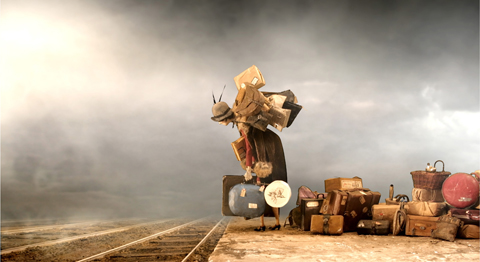
When I am travelling to work on the London Underground, one of my favourite things to do whilst stood inert on the escalator is to look at all the people passing me on the other side (especially at Waterloo and Holborn Station!). The realisation that all these people have their own stories; dreams, struggles, history and have at least once considered what their purpose is here on Earth, always awes me. I most probably won’t see these people again, our paths are crossed and for that moment we find ourselves in the same place, yet we do not know each other, we do not talk, they aren’t ‘Human-ised’ – they remain a stranger to my world: silent. What I do know however, is that all these people have a suitcase on their head – a suitcase filled with their memories, learned behaviour, parental expectations, painful childhood experiences, hopes and dreams, ideals of the Self and happiness, basically everything that makes up a person is in this suitcase, carefully balanced on the base of their head, sometimes supported by the hands if weight and imbalance necessitate.
As you’re walking on your path, heading in your direction, perhaps stumbling around, running fast, reaching a fork in the road, whatever you’re doing on your path, you have your suitcase on your head. In this suitcase you accumulate everything, the mind unless trained in ‘letting go’ becomes a sort of hoarder of existence. The brain itself has the capacity to store almost unlimited amounts of information indefinitely, so everything you’ve experienced, even if you cannot recall it at a moment’s notice, it is still in your suitcase, just because you aren’t conscious of it, doesn’t mean it isn’t there. Even if you think you have forgotten something on the basis that that memory no longer exists, science has found forgetting is more akin to a temporary or permanent inability to retrieve a piece of information, rather than a loss of it.[1] If this suitcase becomes cluttered, heavy, full of things that no longer serve you, you stop living in the Now. You could develop anxieties for the future, depressions from the past, or perhaps become so concerned with this balancing act, pretending that the suitcase sits just fine so that you can fit in, that the strain on your head and shoulders can be temporarily numbed with some medication or a new purse, that you end up forgetting to be alive.
I had not realised that my suitcase had become extremely and dangerously heavy. I was not conscious, or perhaps chose not to be conscious of the repressed memories and emotions, especially from my childhood – the fear of failing, the messy divorce of my parents, the need to academically be the best in order to have any self-esteem. I had externalised my value and self-worth onto man-made constructs, to the point that I never actually felt proud of my achievements, even when they placed me in the top global percentile, I was not happy. I could boast about it, rely on some illusion of imagined superiority, but when it came down to basics, no amount of A*’s can ever compare to your real value – this is immeasurable. If self-worth does not come from the core being, from You, you will never be satisfied.
The deception of my strong foundation all came crashing down when I found myself in a very stressful period of my life, and I felt I could handle it, but I wasn’t aware that I was even carrying this suitcase on my head. I didn’t know I had to factor it into my survival. I collapsed. This is that part of the story where you here about the life-change that happened during that breakdown, you always find that people discover a new sense of Self and who they are when they hit rock bottom; when they have to stand-up by themselves, that’s normally when we realise that hold on, I haven’t actually ever done anything solely for myself (not out of ego, but self-compassion). This becomes an issue of survival – not just physical, but mentally. From any great misfortune can come the most beautiful blossoming – here’s the catch, it doesn’t happen by itself, it requires your conscious and continuous tending to. That point where You change, does not need to be caused by some magnificently dramatic event, there are stories of people coming face to face with suicide, or perhaps venturing out into the unknowns of the Amazon or Himalayas, these are all in themselves beautiful, but your moment could be as simple as sitting in Hyde Park feeling the wind, hearing the birds and smelling summer.
What I learnt from my time at the bottom and going forward, is that there will be points in your life when you really have to stop and consider the weight of this suitcase. You have to have enough love and compassion for yourself to find the time and way, perhaps even help, to just get that suitcase on the ground, open it up and see what no longer serves you. See what is hiding in the corners, get rid of dirty laundry, get rid of other people’s dirty laundry! Really confront your suitcase, inspect it like London Heathrow does with flights from the Middle East!
If you’re brave enough, invite a professional over to help you go through what’s in your suitcase. They can be that guiding light, perhaps gently drawing your attention to material which perhaps you missed or didn’t want to see (and there’s nothing wrong with that – no judgement!). The thing with therapy I have found, and I have fortunately had an excellent experience thus far, is that it necessitates you sitting down with you (especially if you choose psychotherapy). I always felt I knew my Self quite well, having studied psychology and philosophy, I felt comfortable but with the Self that I had created, not with who I actually was. If you’re not comfortable with therapy yet, perhaps you have a trusted family member or friend that feels deeply and could guide you, or next best option: books! I’ve been digesting these and shall post a list of self-growth books I have found particularly helpful.
The suitcase analogy came to me when I was trying to explain and justify really the concept and nature of therapy to family members, who just really for lack of education and awareness, weren’t familiar with therapy. I have found this rings particularly true with non-Western cultures (grant me this broad and flawed generalisation for the point of argument), but discussing therapy with the Middle Eastern-side of my family was like telling them I am now leaving society to be tied up in a small, white, padded room, that said however, I am also Portuguese and the same lack of understanding was found on that side. Even though the mental-health taboo is still present in our British society, with the rising levels of stress, anxiety and depression reported by the NHS to go up to 1 in 3 reporting mental-health problems by 2030, I can guarantee you, millions of more people are going to have to take some pauses and open that suitcase up, not just you.
Our world has led to so many of us existing in a singular plane, that we no longer are able to connect with our souls (if you don’t like the concept soul, perhaps take it more as the ‘autonomic self’ or your ‘inner being). We spend a lot of time doing things that fail to nourish us, that fail to challenge us, how possibly could we become attuned with our minds when we are busy meeting project targets or avoiding a horrible boss? Those of you who have the courage, compassion and audacity to open your own suitcase, well that is what strength is made of. The struggle with the world is hard and exhausting, but the knowing and mastering of one’s own mind? Well, that’s as rare as a red diamond.
When experiencing complicated and intense feelings for the first time, it may be hard to determine whether these emotions are related to depression or other mental health issues. Learn the signs of depression and when to get help in this BetterHelp article.
[1] http://www.human-memory.net/processes_storage.html

Latest posts by (see all)
- EVENT | PASS THE TORCH FOR TY RETURNS TO BRIXTON FOR ITS SIXTH ANNUAL CELEBRATION — August 13, 2026
- DIASPORA CALLING! REVIEW: LAURYN HILL, ERYKAH BADU AND 35,000 PEOPLE CELEBRATE THE POWER OF BLACK CULTURE — August 13, 2026
- REVIEW | ROOTS PICNIC: A HIP HOP UTOPIA AT CRYSTAL PALACE BOWL — August 13, 2026
