There are festivals, and then there are cultural moments. Diaspora Calling! firmly belonged to the latter.
More than 35,000 people descended on Milton Keynes National Bowl for the landmark UK event, conceived and curated by Ms. Lauryn Hill and hosted by Dave Chappelle. Bringing together generations of hip hop, R&B, soul, reggae, Afrobeat, Afrobeats and UK rap, the day felt less like a conventional festival and more like a huge family gathering for the global African diaspora.
The line-up alone carried serious weight. Ms. Lauryn Hill, Wyclef Jean, Erykah Badu, Giggs, Fireboy DML, YG Marley, Zion Marley, Seun Kuti and The Compozers all appeared, alongside DJ sets from DJ OBI and Michael Brun.
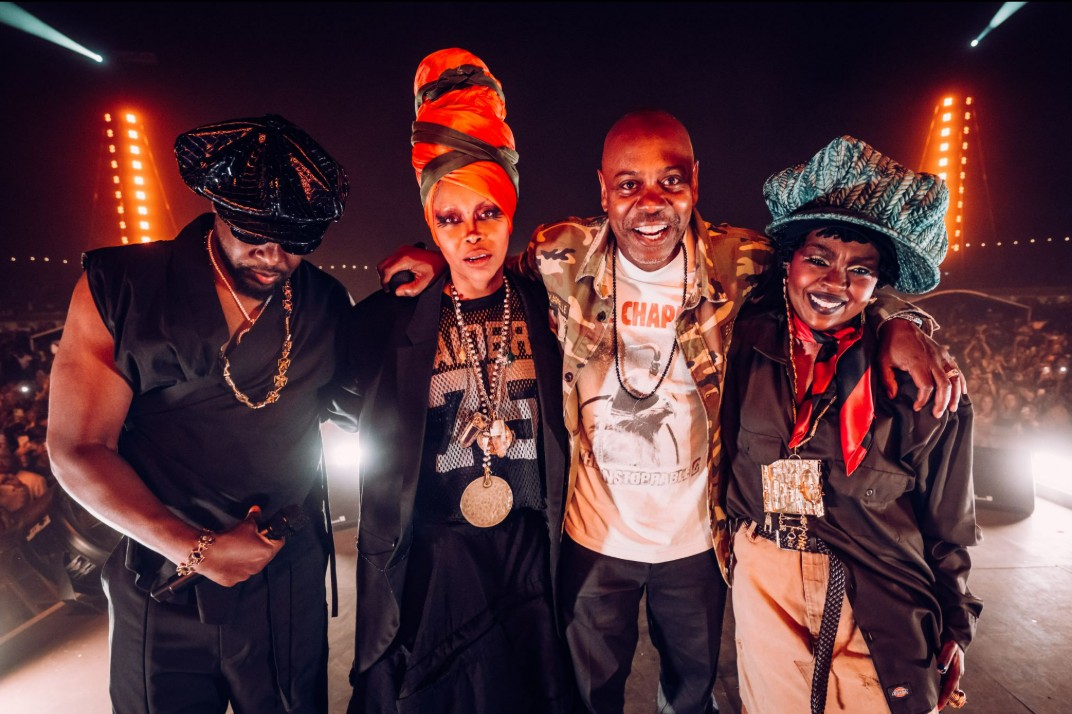
Dave Chappelle was a commanding presence throughout the event. More than simply a host, he helped frame some of the day’s biggest moments with the sharpness and cultural awareness that have defined his career. His appearances connected a programme spanning generations, continents and genres, giving the festival a sense of purpose beyond the performances themselves.
Erykah Badu delivered the effortless, otherworldly presence audiences have come to expect from her. Moving through songs including ‘Apple Tree’, ‘Window Seat’, ‘On & On’ and ‘Back in the Day’, she reminded the National Bowl why her influence continues to stretch far beyond neo-soul. Badu does not simply perform her music; she creates her own atmosphere and invites the audience to step inside it.
British rap was represented by Giggs, whose set produced one of the day’s biggest surprises when Kano joined him onstage. Hearing ‘P’s & Q’s’ and ‘Rudeboy’ at the National Bowl brought together two defining voices in UK rap. It was a powerful moment that recognised the history and evolution of a scene that once had to fight for space at major British events.
Fireboy DML represented the global rise of Afrobeats, while Seun Kuti brought the force, musicianship and political spirit of Afrobeat to the stage. YG Marley performed his global hit ‘Praise Jah in the Moonlight’, and Zion Marley honoured his grandfather Bob Marley with ‘Three Little Birds’ before performing his own track, ‘Best of Me’.
These performances captured the wider vision behind Diaspora Calling!: a celebration of the musical and cultural connections that have travelled between Africa, the Caribbean, the UK, the US and Black communities around the world.
The closing performance belonged to Ms. Lauryn Hill and Wyclef Jean, who reunited to celebrate the 30th anniversary of The Fugees’ landmark album, The Score. Hearing ‘Ready or Not’ and ‘Fu-Gee-La’ performed three decades later demonstrated just how little their power has diminished.
The set also travelled through Hill and Jean’s individual catalogues. Wyclef delivered ‘911’, while Hill performed solo favourites including ‘Ex-Factor’ and ‘To Zion’. YG Marley and Zion Marley joined them onstage, creating a moment that connected musical history, family legacy and a new generation.
Then came one of the night’s defining moments.
The Compozers accompanied Hill during the closing set, adding the richness and live musical energy for which they have become known. With Hill, Wyclef, Badu and the Marley family all contributing to the finale, the stage became a living representation of the festival’s cross-generational purpose.
Diaspora Calling! was not without the challenges that come with staging such an ambitious programme. With so many artists, genres and cultural ideas competing for attention, parts of the event could feel expansive rather than tightly focused. However, its greatest strength was precisely that ambition. This was never designed to be just another sequence of performances. It was attempting to build something much broader.
The festival also used its platform to address the political realities facing Black communities. MP Bell Ribeiro-Addy delivered a message from Hill centred on reparatory justice, strengthening connections across the African diaspora and creating the institutions and opportunities needed for communities to shape their own futures.
It was an important reminder that Diaspora Calling! was not simply celebrating culture as entertainment. It was also recognising culture as history, resistance, ownership and collective power.
The scale of the occasion was reflected backstage, where Gunna, Common, Rapsody, Tiwa Savage, Little Simz, Stonebwoy, Victony, Derek Chisora, Sabrina Elba, Tolu Coker, Zeze Millz and Foday Dumbuya were among the artists and cultural figures spotted. Their presence reinforced the feeling that something significant was taking place.
That cultural footprint stretched beyond Milton Keynes. In the days leading up to the festival, Hill and Wyclef met fans at 180 Studios to sign albums, memorabilia and exclusive merchandise marking 30 years of The Score. Meanwhile, Lauren Halsey’s takeover of the Piccadilly Lights transformed one of London’s most recognisable landmarks into a public celebration of Black imagination, memory and community.
At its heart, Diaspora Calling! was about connection: between continents, genres, generations and different expressions of Black identity. It celebrated the artists who laid the foundations while making space for those carrying the culture forward.
With Lauryn Hill at its creative centre, the event demonstrated an ambition extending far beyond the traditional festival format. From Kano joining Giggs to Erykah Badu sharing the stage with Hill, the day delivered the kind of moments that will live on long after the final song.
The UK debut of Diaspora Calling! was bold, imperfect, historic and necessary. More importantly, it created a major new platform where diaspora culture was not treated as a trend or a side attraction. It was the main event.
And with 35,000 people gathered to witness it, the message could not have been clearer: the diaspora is not waiting to be invited in. It is building its own stage.


Rishma
Latest posts by Rishma (see all)
- ON STAGE | JULIUS CAESAR REMIXED AT OMNIBUS THEATRE — September 23, 2026
- EVENT | PASS THE TORCH FOR TY RETURNS TO BRIXTON FOR ITS SIXTH ANNUAL CELEBRATION — August 13, 2026
- DIASPORA CALLING! REVIEW: LAURYN HILL, ERYKAH BADU AND 35,000 PEOPLE CELEBRATE THE POWER OF BLACK CULTURE — August 13, 2026
