
At some point, somebody decided that art needed to start behaving like a business. Songs became content, listeners became data points, and the question “Is it any good?” was invited to sit quietly in the corner while everybody discussed whether it would perform. Under those conditions, making something strange, personal and lovingly ambitious can feel like a small act of rebellion. Making an entire hip-hop record about the business of making art? Well, that deserves a much bigger round of applause.
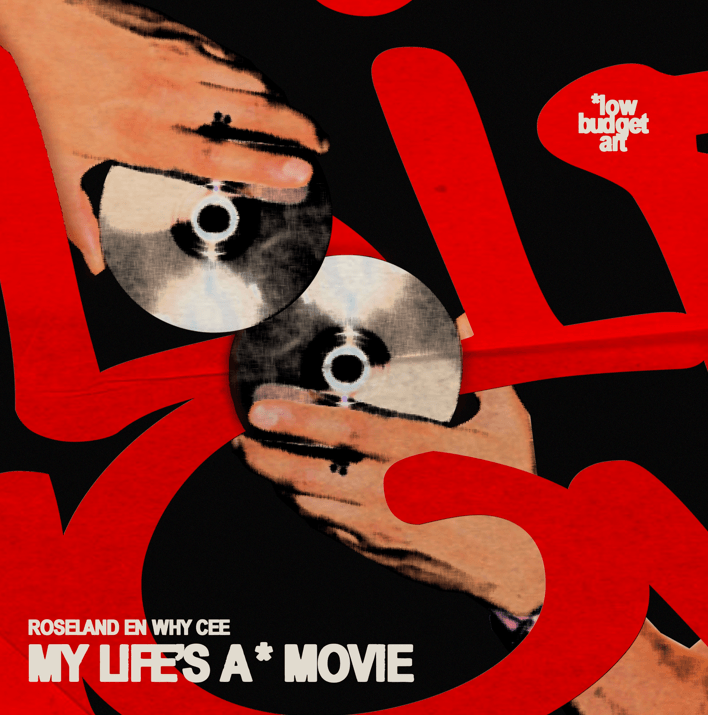
On MY LIFE’S A (low budget art) MOVIE, South London rapper and producer Roseland En Why Cee takes us into the world of an aspiring filmmaker and turns his creative journey into a witty, thoughtful and thoroughly engaging piece of alternative hip-hop. It is a record about ambition, compromise and friendship, and the struggle to hold on to your creative vision when the pressure to make art pay begins to close in.
Released on 11 November, the project unfolds across five main songs, linked by brief spoken interludes and finished off with its own credits. It has a cast, a narrative arc and enough love for cinema to make you want to spend the next month in a darkened room watching films you have been meaning to get around to. Yet for all its movie-making machinery, this is a story that reaches well beyond the film set. If you have ever made something simply because you felt compelled to, Roseland has made a little space here for you.
Lights, camera, imagination
Roseland En Why Cee, the musical alias of Nathan Jamal, approaches his fictional filmmaker with affection, humour and just enough mischief. Our protagonist wants to make his mark, and the album follows him through the creative process, into the seductive world of bigger budgets and towards a renewed appreciation of the people and passions that got him started.
It is a clever premise, but what makes it so appealing is how much life sits inside it. There is warmth in the recognition that behind every grand artistic statement is a collection of people trying to get things made: friends sharing ideas, collaborators bringing their gifts, and someone, somewhere, waiting patiently to be paid.
Opening track “Life On Set”, featuring Riketté, takes us straight into that world. Roseland populates his set with writers, runners, directors and all the little hierarchies that spring up when creative people gather in one place. There is affection in the detail, along with a sharp eye for the absurdity of it all. The filmmaking references give the song its setting, while the familiar experience of loving your work and still needing somebody to settle your invoice gives it its wink of recognition.
There is a touch of Tom DiCillo’s Living in Oblivion in that eye for the people behind the picture. DiCillo’s comedy follows the cast and crew attempting to make an independent film, complete with the personalities and practical chaos that come with the job. Roseland gives us his own lively collection of characters, reminding us that every cinematic dream needs a room full of actual people to make it happen. And, ideally, somebody to pay their invoices.
A short film for your ears
Hip-hop has a wonderful history of artists treating an album as a world to step inside, and Roseland’s project makes an engaging addition to that tradition. Jean Grae’s Gotham Down series builds an intricate universe around a time-travelling assassin, letting characters, imagery and storylines unfold across its three cycles. Roseland’s filmmaker is navigating a rather different set of professional hazards, but there is a shared pleasure in allowing the listener to piece together a bigger picture from the details along the way.
Masta Ace’s Disposable Arts offers another compelling point of comparison. Its fictional Institute of Disposable Arts provides the setting for an album-length story concerned with hip-hop and the world around it. Like Ace, Roseland understands that a creative setting can hold a whole collection of questions about ambition, identity and what happens when artistic dreams meet the realities of an industry.
There are exciting reminders of early Kendrick Lamar, too, both in Roseland’s conversational delivery and in the way the project uses voices and interludes to bring its setting to life. Kendrick gave good kid, m.A.A.d city the subtitle “A Short Film”; Roseland offers his own cinematic invitation, with an independent filmmaker at its heart and a cast of collaborators helping to tell the story. The settings and stories are their own, but both records appreciate what can happen when the space between songs becomes part of the picture.
There is a connection to Pedro Almodóvar’s Pain and Glory, another work that places a filmmaker at its centre while blurring the edges between an artist’s life and the stories they choose to tell. Almodóvar looks back through memory; Roseland sends his character out in pursuit of a dream. Both recognise that making art is tangled up with being a person, with all the ambition, uncertainty and emotional baggage that entails. The camera, it turns out, is pointing in more than one direction.
The art of knowing what to leave in
On “Genius Is in the Edit”, featuring R.A.P. Ferreira, the record turns its attention to the decisions that shape a creative work. The title alone could be pinned above the desk of every writer, filmmaker and producer who has ever fallen hopelessly in love with something that does not quite belong in the finished piece. Sometimes the brilliant bit has to wait for another day. Sometimes the cutting-room floor is where good ideas go to become future possibilities.
The track’s recurring thought about leaving material out if it doesn’t serve the narrative gives the song an organising principle. Around it, the writing moves through images and ideas that reward another listen. It is a lovely reflection of the album itself: a compact project with a clear sense of its own world, and plenty happening inside the frame.
There is a particular pleasure in writing that doesn’t immediately reveal all its secrets. A phrase catches your ear, another image follows, and for a moment you’re enjoying the journey without quite knowing where it’s taking you. Then a later line arrives and the earlier one lights up. Across Roseland’s writing and the contributions of his collaborators, this is an album that rewards that kind of attention: listen again, follow the thread, and another connection begins to emerge.
It is a quality that calls to mind the lyrical detours of Lupe Fiasco and the associative writing of Ferreira himself. In an interview with Wordplay, Roseland named Lupe Fiasco and Kaelin Ellis’s House as an influence on the shape and tone of the project, and there is a shared willingness to let an idea take an interesting route.
And, perhaps unexpectedly, there is a distant kinship with Joni Mitchell: a songwriter who understood that an image could be a scene, a feeling and a doorway into something much bigger, all at once. Think of the roads and journeys of Hejira, or the way “Amelia” lets a story of flight gather emotional meaning. These are different artists working in different traditions, but there is a shared faith that the listener will come along for the ride.
Dreams, trumpet and the big break
“Dream Sequence”, featuring MAX GRISE, takes us further into the filmmaker’s imagination. Its imagery moves between dreams, screens and the slippery space between what we see and what we understand. Grifton Forbes-Amos’s trumpet adds another colour to the track’s cinematic palette, helping to place us inside a world where reality and aspiration are in constant conversation.
Federico Fellini’s 8½ found a whole universe inside the mind of a filmmaker, moving between the practical demands of making a movie and the dreams, memories and fantasies that surround it. Roseland’s “Dream Sequence” opens a door into that imaginative territory too. And when Fellini’s name turns up later in “Netflix Budget”, it gives the reference an extra wink: here is an artist thinking about what happens to a creative vision when a very different kind of movie deal comes calling.
“Netflix Budget”, featuring MAX GRISE, is where our filmmaker gains access to a rather different set of possibilities. There are luxury accessories, international locations and the sort of spending decisions that might make an independent artist’s accountant burst into tears of joy. The track has a playful swagger, but its humour carries a pointed question: what happens when artistic ambition comes face to face with an industry that knows exactly how it would like that ambition packaged?
The lavish details build an entertaining picture of success, before gradually revealing more about the choices behind the spectacle. Roseland has spoken about the influence of Spike Lee’s Bamboozled on this part of the story, and that connection gives the satire an added edge. There is something compelling about an independent artist exploring the seductions of the mainstream from within a fictional character’s head. The glamour is part of the story; so is the cost of letting other people decide what your work needs to be.
It is a subject that feels especially relevant now. We live in an age when artists are expected to be their own marketing departments, content creators and publicity machines, preferably while producing something that will hold the attention of a person scrolling with one thumb and watching television with the other. Capitalism has a remarkable talent for taking the things people make out of love and asking whether they might be more profitable if they were shorter, louder and available on a branded water bottle.
Which is why projects like this matter. Every time an independent artist makes a record with a distinct point of view, brings their friends into the process and invites listeners to meet the work on its own terms, they help wrestle a little power back. Roseland’s album celebrates the freedom to make something specific: an idea with personality, humour and a reason to exist beyond a set of engagement figures.
The people behind the picture
That spirit comes into focus on “All I Need”, featuring Seriez and Dustin D’Wind. The track returns to the pleasures that first set the imagination running: films, friends, memories and the simple excitement of making something together. Its lyrics move through a wonderfully eclectic collection of cinematic touchstones, from Spike Lee to Ghost in the Shell, suggesting a creative mind with a well-stocked shelf and a genuine appetite for stories.
There is a little of the spirit of Michel Gondry’s Be Kind Rewind here. In the film, people in a New Jersey community come together to remake films with everyday materials, a camera and enough imagination to fill a multiplex. On “All I Need”, Roseland returns to that same pleasure of making something with the people around you.
He told Occhi Magazine that the track grew from memories of recording with friends as a teenager, eventually bringing longtime friends together to share a microphone. Different stories, perhaps, but a shared affection for the beautiful things that can happen when somebody has an idea and their friends say, “Go on, then.”
The album’s final “Credits” extends that generosity to the people who helped make it. It is a fitting curtain call for a project that understands art as a conversation between collaborators. Roseland may be our leading man, but he makes sure we see the cast and crew.
A film worth staying for
MY LIFE’S A (low budget art) MOVIE is inventive, funny and full of heart. It is a record with ideas about how art is made and what happens when creative ambition meets the machinery of an industry, but it wears those ideas with a light touch. Roseland gives us characters, images, collaborators and enough cinematic references to make a film nerd very happy, while keeping the human story at the centre.
It is also a reminder of how exciting independent music can be. Here is an artist taking an idea seriously, playing with form and inviting us into a world built with imagination and community. In a landscape that increasingly tries to measure art by how efficiently it can be consumed, that feels worth celebrating.
The album opens with Roseland declaring, “Don’t roll the credits on me as I walk into the sunset.” After a project of this imagination, ambition and excellence, I don’t think anyone will be rolling those credits just yet. This feels like the beginning of something artistically special, and I, for one, have already settled in for the sequel.
Listen: MY LIFE’S A (low budget art) MOVIE on Bandcamp

Micky Roots
Latest posts by Micky Roots (see all)
- Lights, Camera, Independence: Roseland En Why Cee’s Low-Budget Movie Is a Sonic Triumph — November 27, 2026
- SOMETHING OLD, SOMETHING NEW | BACK ON THE DECKS ‘OUTKAST ‘ATLIENS’ — November 24, 2026
- OPINION PIECE | BEEF — November 17, 2026
