
BACK ON THE DECKS
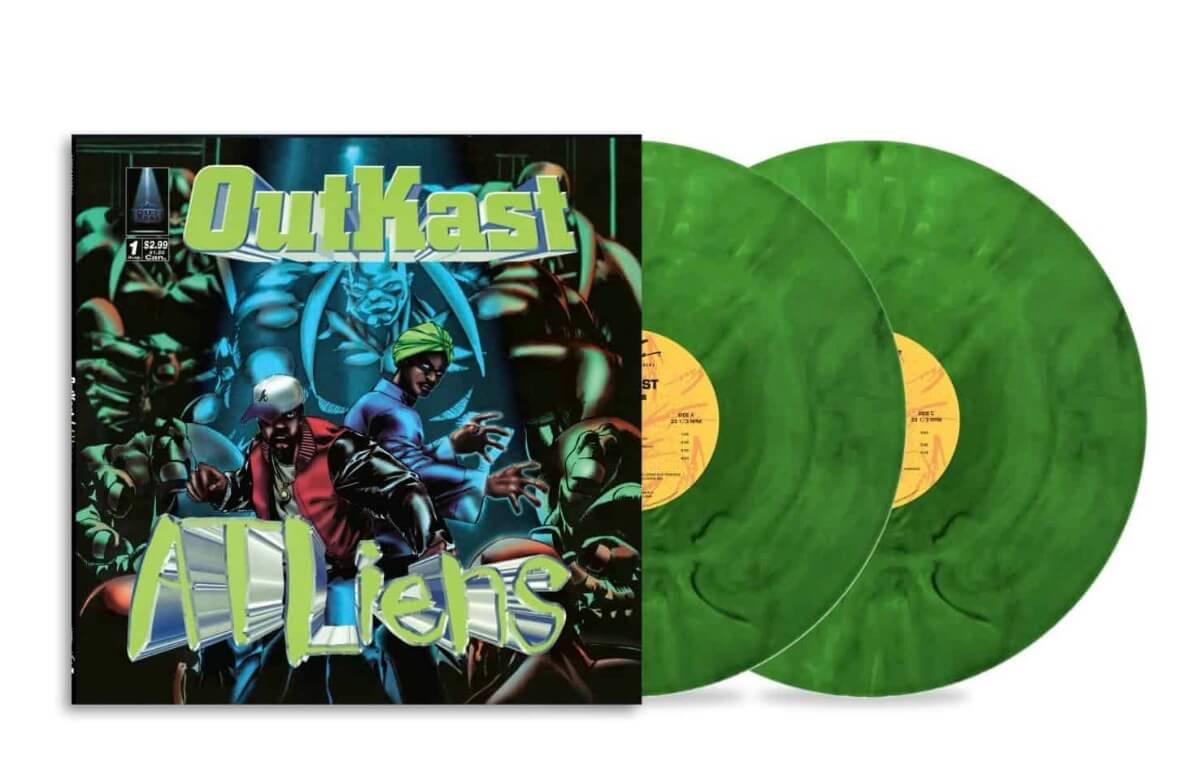
OutKast — ATLiens (1996)
There are albums that sound like the year they were made, and then there are albums that sound as though they were beamed in from a year nobody has got around to inventing yet. OutKast’s ATLiens, released in August 1996, belongs firmly in the latter category. Thirty years on, it still sounds like two young men listening to the future through the walls.
There’s something rather wonderful about the fact that André 3000 and Big Boi were only 21 when this record was released. At an age when most of us were still making questionable decisions, these two were quietly reconsidering what Southern hip-hop could sound like, what it could say, and where it could go. The exuberant swagger of their debut, Southernplayalisticadillacmuzik, hadn’t disappeared, nor had the Cadillacs, the funk or the fascination with the opposite sex. But something had changed. The two young men who had introduced themselves to the world in 1994 were beginning to question that world, their place within it and, perhaps most interestingly, what happens when the things you’ve always wanted start arriving.
From Cadillacs to Cosmos
To appreciate ATLiens, it’s worth remembering what OutKast were up against. In the mid-nineties, hip-hop was still dominated by the East and West Coasts, both geographically and culturally. New York had its lyrical purists, Los Angeles had its G‑funk superstars, and the South was frequently treated like an enthusiastic younger cousin who hadn’t quite earned a seat at the grown-ups’ table.
At the 1995 Source Awards, André famously declared that the South had something to say, addressing an audience that hadn’t been especially welcoming to the Atlanta duo. But what’s interesting about ATLiens is that OutKast didn’t respond to that hostility by trying to sound more like New York or Los Angeles. Instead, they went further into themselves. If the industry considered them outsiders, they would embrace the designation and make an entire musical universe out of it.
Even the title is a clever little invention, merging Atlanta with aliens and alienation. The comic-book artwork presents André and Big Boi as extraterrestrial adventurers navigating a strange, threatening landscape. It’s playful, certainly, but it also captures the record’s central preoccupation: the peculiar experience of being completely at home in your surroundings and somehow separate from them.
But there was considerably more to this than an imaginative visual identity.
The album explores spirituality, material success, relationships and mortality with a seriousness that occasionally makes you forget just how young its creators were.
Where their debut had largely celebrated the world around them, ATLiens was beginning to interrogate it. Atlanta remained central to their musical identity; they’d simply discovered that its possibilities extended considerably further than the city limits.
Houston, We Have a Bassline
Musically, ATLiens is a masterclass in knowing when to leave things alone. Their debut had been filled with rich arrangements drawing heavily on Southern funk and soul. Much of that DNA remains, but the production here feels more spacious, atmospheric and occasionally faintly unsettling. Synthesised textures hover over deep basslines, drums sit confidently in the pocket, and melodies appear and disappear like distant transmissions. It’s an album that makes tremendous use of space, which is rather appropriate given the concept.
Organized Noize, whose work helped establish the Dungeon Family sound, remain important contributors, but André and Big Boi were increasingly involved in their own production. Rather than relying on densely layered arrangements, they frequently allow a handful of musical ideas to carry an entire track. It’s deceptively difficult. Any producer can keep adding instruments until a song feels full; the real challenge is knowing which ones to remove without everything collapsing.
Take “Elevators (Me & You)”, arguably the album’s most recognisable track. The production is wonderfully economical, built around a hypnotic melodic figure, restrained percussion and a bassline providing just enough movement to keep everything gently rolling forward. The spaciousness gives both rappers room to explore their thoughts without competing against an instrumental desperate to show off.
Rather than celebrating fame with the extravagance that would later become a hip-hop industry standard, OutKast seem more interested in examining what fame actually means.
The title track is equally fascinating, its bass-heavy groove establishing something distinctly Southern yet difficult to place within any conventional regional category. “Jazzy Belle” brings an almost spectral quality to the album, while “Babylon” combines personal reflection with observations about the social forces shaping the world. Throughout, there’s a coherent musical language at work, giving ATLiens the atmosphere of a complete world rather than a collection of unrelated beats.
Two Rappers, Three Drummers
One of the things that struck me most when revisiting ATLiens was something I don’t think gets discussed nearly enough: the extraordinary relationship between the vocal performances and the rhythmic architecture of the production. We often describe rappers as riding a beat or flowing over an instrumental, as though the music is a fixed structure and the voice simply occupies the available space. But listen closely to André and Big Boi here, and something considerably more sophisticated is happening.
Big Boi, in particular, has a remarkable ability to integrate his delivery into the percussion itself. His syllables frequently align with the kick and snare patterns so precisely that the distinction between rapper and rhythm section begins to dissolve. Hard consonants provide additional percussive accents, internal rhymes introduce subdivisions of the beat, and rapid changes in phrasing create rhythmic patterns that the instrumental alone doesn’t contain. At times, his voice effectively becomes another drum, contributing to the groove rather than merely following it.
What’s especially impressive is that he achieves this without sounding rigid. His timing is precise, but there’s a looseness to the way he moves around the beat. He can anticipate an accent, delay a syllable or carry a phrase across a bar line while maintaining that unmistakable Southern swing. The result is something approaching a polyrhythmic conversation, where the vocal delivery introduces its own rhythmic organisation against the underlying drums.
André approaches things differently, which is precisely why the partnership works so beautifully. His delivery is more elastic, with greater variation in pitch, emphasis and the duration of individual syllables. Where Big Boi often reinforces the rhythmic momentum, André seems interested in stretching it, occasionally lingering over a phrase or placing an accent somewhere you wouldn’t expect. The beat might remain constant between verses, but the sensation of movement changes completely.
These aren’t simply two technically gifted rappers performing over excellent instrumentals.
They’re participating in the construction of the music itself. It’s a remarkable achievement, particularly on a record whose uncluttered production makes these subtleties so apparent once you start listening for them. There are plenty of impressive rappers in hip-hop history, but relatively few partnerships where the interplay between contrasting vocal deliveries becomes such an essential part of the music’s identity.
Growing Up Is a Funny Old Business
For all its cosmic imagery, ATLiens is an extraordinarily human record. Much of it concerns the uncomfortable business of growing up, discovering that success doesn’t necessarily provide certainty and recognising that the world might be considerably more complicated than you were led to believe.
On “Babylon”, André reflects on his early life while the song examines sexual morality, institutional authority and social judgement. “Mainstream” questions conformity and the pressures of the music industry, while “Millennium” places personal ambition against the rather more intimidating backdrop of mortality and an uncertain future. These aren’t lightweight subjects, but OutKast have the good sense not to approach them as though delivering a series of compulsory lectures. Their observations emerge naturally, accompanied by humour, contradiction and the sort of everyday detail that makes them believable.
“13th Floor / Growing Old” is particularly affecting. There’s something almost absurdly precocious about two men in their early twenties contemplating the passage of time so seriously, yet the song captures that strange moment when you realise life is actually happening, decisions have consequences and the future, once reassuringly distant, has started making itself inconveniently present.
What I appreciate is that OutKast don’t attempt to resolve these anxieties. Success brings opportunities but also responsibilities; relationships provide comfort but also confusion. It’s an unusually thoughtful perspective for an album that also contains plenty of wonderfully entertaining nonsense.
You can contemplate the human condition without permanently misplacing your sense of humour.
Still Out of This World
There’s a temptation to describe ATLiens as a transitional album, positioned between the youthful exuberance of Southernplayalisticadillacmuzik and the extraordinary creativity that would follow with Aquemini, Stankonia and Speakerboxxx/The Love Below. But I’ve never been comfortable with that description. It makes ATLiens sound like a corridor between two more interesting rooms, when it’s a remarkable achievement in its own right.
What makes the album special is the completeness of its vision. The production, writing, artwork and performances all belong to the same imaginative world. It’s experimental without being self-indulgent, musically sophisticated without sacrificing accessibility, and deeply rooted in Southern hip-hop while refusing to accept anybody else’s limitations on what that might mean. OutKast demonstrated that regional identity and artistic innovation weren’t mutually exclusive. They didn’t need to abandon Atlanta to explore new musical territory, nor imitate the established centres of hip-hop influence to be taken seriously.
Thirty years later, so much of what once made OutKast unusual has been absorbed into hip-hop’s broader vocabulary. Genre-blending, unconventional vocal performances, introspective Southern rap and ambitious conceptual albums are no longer especially surprising. It’s easy to forget just how much ground was being broken in Atlanta in the mid-nineties.
And perhaps that’s the most compelling reason to take ATLiens back off the shelf. Not simply because it’s a classic, but because it remains a genuinely fascinating listening experience. The production still sounds inventive, the performances reward close attention, and its questions about identity, success and belonging haven’t exactly become less relevant. Thirty years ago, OutKast imagined a future for hip-hop that the rest of the world hadn’t quite caught up with.
The extraordinary thing is how much of that future we’re now living in.
Key Tracks: Elevators (Me & You), ATLiens, Babylon, 13th Floor / Growing Old.

Micky Roots
Latest posts by Micky Roots (see all)
- SOMETHING OLD, SOMETHING NEW | BACK ON THE DECKS ‘OUTKAST ‘ATLIENS’ — November 24, 2026
- OPINION PIECE | BEEF — November 17, 2026
- OPINION PIECE | FROM BEBOP TO BOOM BAP: JAZZ AND HIP-HOP’S FAMILY RESEMBLANCE — November 17, 2026
