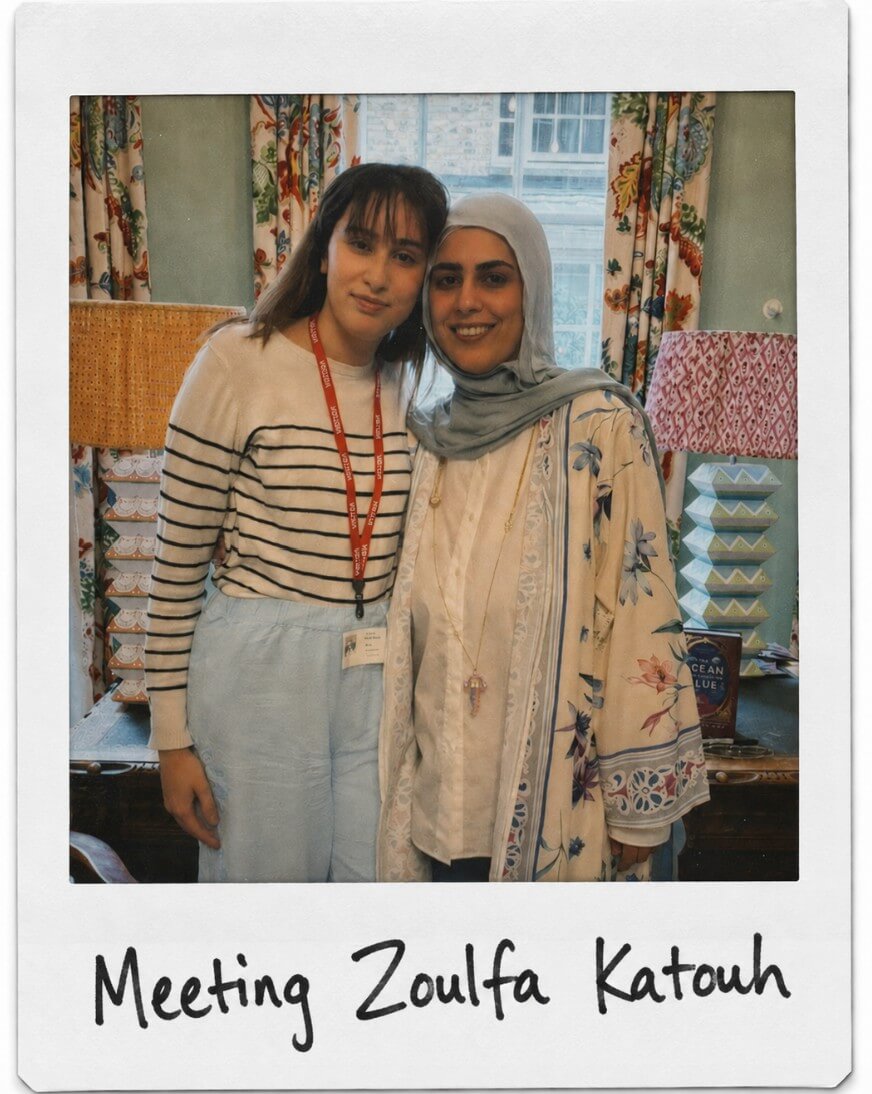
When I first interviewed Zoulfa Katouh, I was just beginning my journey as an interviewer. Nearly two years later, sitting down with her again felt less like an interview and more like catching up with someone whose stories have quietly shaped the way I think about home, grief, and identity.
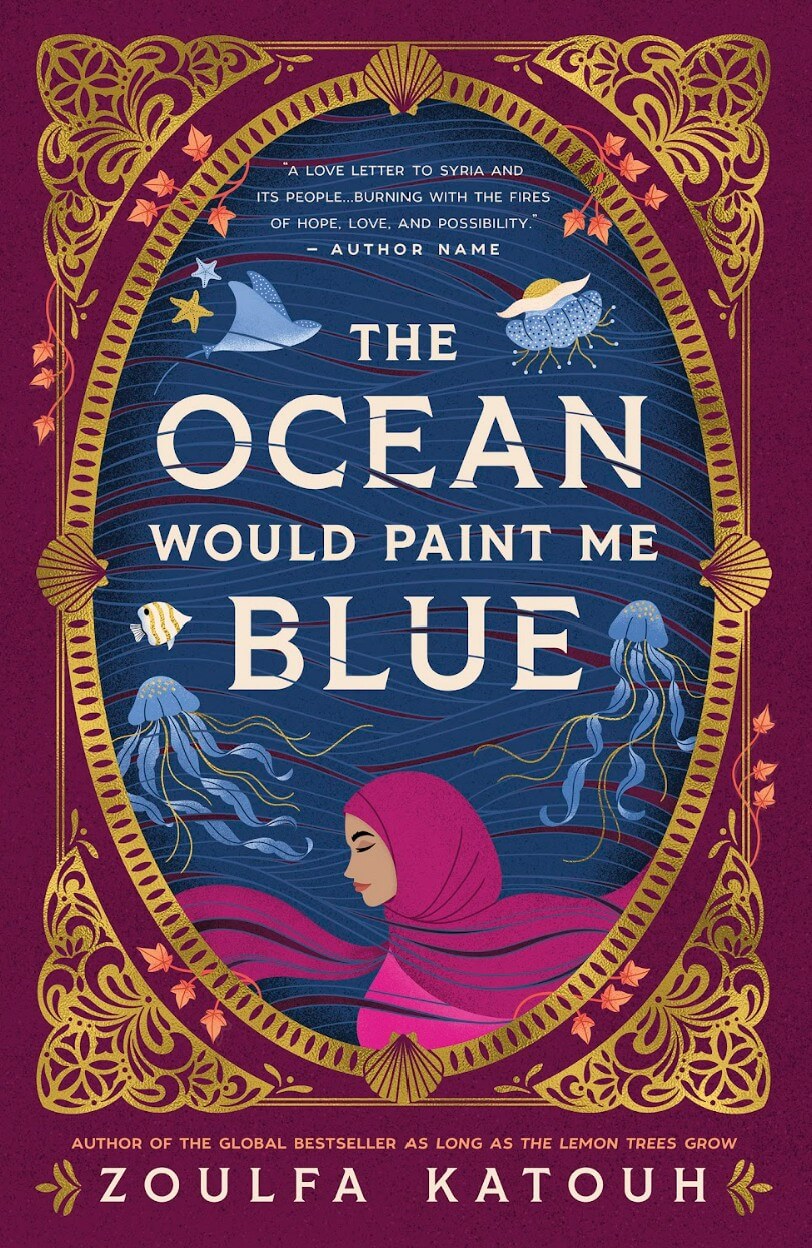
Her latest novel, The Ocean Would Paint Me Blue, arrives after the global success of As Long As The Lemon Trees Grow. While both novels explore displacement and belonging, this time Katouh turns her attention to a different kind of loss: the grief of living between worlds, of carrying a homeland in your heart that you may never have fully known.
For someone like me — Palestinian/Lebanese by heritage, Austrian by nationality, yet having never lived in either place — the novel resonated deeply.
Across both books, home feels like something the characters are constantly searching for. When I asked Katouh what home means to her today, her answer was immediate.
“Home for me is not a country anymore,” she tells me. “I had to sit and think about that for a long time. Honestly, when you ask the question, I would say home is my family, because I’ve lived with them in every single country I’ve lived in.”
It’s a sentiment that sits at the heart of the novel. Unlike Salama from As Long As The Lemon Trees Grow, who carries Syria in her bones, Jihad’s connection to Syria is inherited through stories rather than memories.
“What Jihad feels towards Syria is something that I feel towards Syria,” Katouh explains. “But with Salama, it was discovering Syria, loving Syria through Salama.”
That distinction feels particularly relevant for diaspora communities, where identity is often shaped by stories passed down through generations rather than direct experience.
One of the novel’s most striking metaphors is Jihad’s inability to see colour after the loss of her mother. The world becomes grey, muted, distant.
Having lost my own father last year, it was a portrayal of grief that felt painfully accurate.
When I mention this to Katouh, she explains that the idea emerged from wanting to capture the isolation that grief creates.
“When someone goes through grief, it’s a very solitary experience,” she says. “You’re seeing the world in grayscale, but you’re not actually seeing it.”
What makes the metaphor particularly powerful is that nobody around Jihad can fully understand what she’s experiencing.
“No one believes her. Alexis believes her to an extent, her sister doesn’t believe her, her father’s checked out. It’s a very solitary thing that she’s going through.”
For Katouh, grief extends beyond the loss of a loved one. It also includes the loss of homeland, community, and the life that could have been.
She describes the Arabic concept of g’erbe — a feeling of estrangement and distance that doesn’t quite translate into English.
“My family is scattered all over the world. We don’t have a family home to go back to,” she says. “I don’t know my cousins that much because we’re not in the same place. It’s difficult.”
Listening to her speak, it becomes clear that The Ocean Would Paint Me Blue is not only a novel about grief. It is a novel about living with grief.
“I don’t think there’s a cure for this,” she admits. “You just live with it.”
One of my favourite discussions centred around Lexie, a character who constantly challenges the reader’s assumptions.
Katouh laughs when I tell her how many times I changed my mind about Lexie.
“A lot of people are Alexis without them knowing it,” she says.
Rather than creating a villain, Katouh wanted to write someone who felt painfully human.
“To herself, she’s not the villain. She’s like, ‘I had to protect myself and be who I am for my own reasons.’”
The conversation naturally moves towards Jamie, one of the novel’s most beloved characters. What makes Jamie particularly compelling is the way his spiritual journey develops alongside his compassion for Jihad. His faith isn’t presented as a destination but as something discovered through empathy, kindness, and human connection.
“I wanted to show the process,” Katouh explains. “A lot of people assume someone converts because they’re marrying a Muslim person, but it’s not always like that.”
While Jihad introduces Jamie to parts of the faith, Katouh describes her as “the final cherry on top” rather than the reason for his journey.
More importantly, Jamie becomes an anchor for Jihad during her grief.
“He grounded her without ever realising it,” Katouh says.
It’s perhaps one of the novel’s most beautiful ideas: that sometimes healing arrives through the people who simply choose to stay.
Towards the end of our conversation, I ask Katouh what part of Syria she carries with her today. Her answer is immediate.
“The history.”
She recently returned to Syria and describes the experience as deeply emotional.
“I was looking around and thinking, I can’t believe I’m actually here. I’m literally walking where my ancestors walked.”
Despite growing up elsewhere, she speaks about Syria with a certainty that many children of diaspora communities will recognise.
“I know that the earth there knows me. It knows who I am.”
It is perhaps the most powerful line of our entire conversation.
Because that is ultimately what The Ocean Would Paint Me Blue explores so beautifully: the idea that home isn’t always somewhere you can point to on a map. Sometimes it exists in family, memory, language, faith, grief, and stories.
What sets Zoulfa Katouh apart as a writer is her ability to make readers feel seen. Her stories speak to those navigating grief, searching for home, carrying multiple identities, or trying to reconcile the distance between where they come from and where they are today. Yet her work never feels exclusive to those experiences. Instead, she writes with a rare emotional honesty that allows readers from all walks of life to find themselves within her pages.
Through lyrical prose, deeply human characters, and themes that transcend borders, Katouh has established herself as one of the most important voices in contemporary young adult fiction. Her novels are the kind that linger long after the final page, making them not only worthy of critical recognition but deserving of a place in classrooms, book clubs, and literary conversations for years to come.
Sometimes, even when you have never truly lived there, the earth still remembers your name.
The Ocean Would Paint Me Blue is Out Now in all book stores.

Salina Zaher
Latest posts by Salina Zaher (see all)
- ON STAGE | RETURN OF THE GODZ REVIEW: A WILD BLEND OF MYTHOLOGY, CIRCUS AND COMEDY — June 16, 2026
- BOOK CORNER | FINDING COLOUR AGAIN IN A GREY WORLD: A CONVERSATION WITH ZOULFA KATOUH — June 11, 2026
- I AM HIP-HOP BOOK CORNER | “BEING DIFFERENT DOES NOT MAKE YOU INCOMPLETE” BEN CAJEE OPENS UP ABOUT IDENTITY, LONELINESS AND HOPE IN PANDA BADGER — May 6, 2026
