
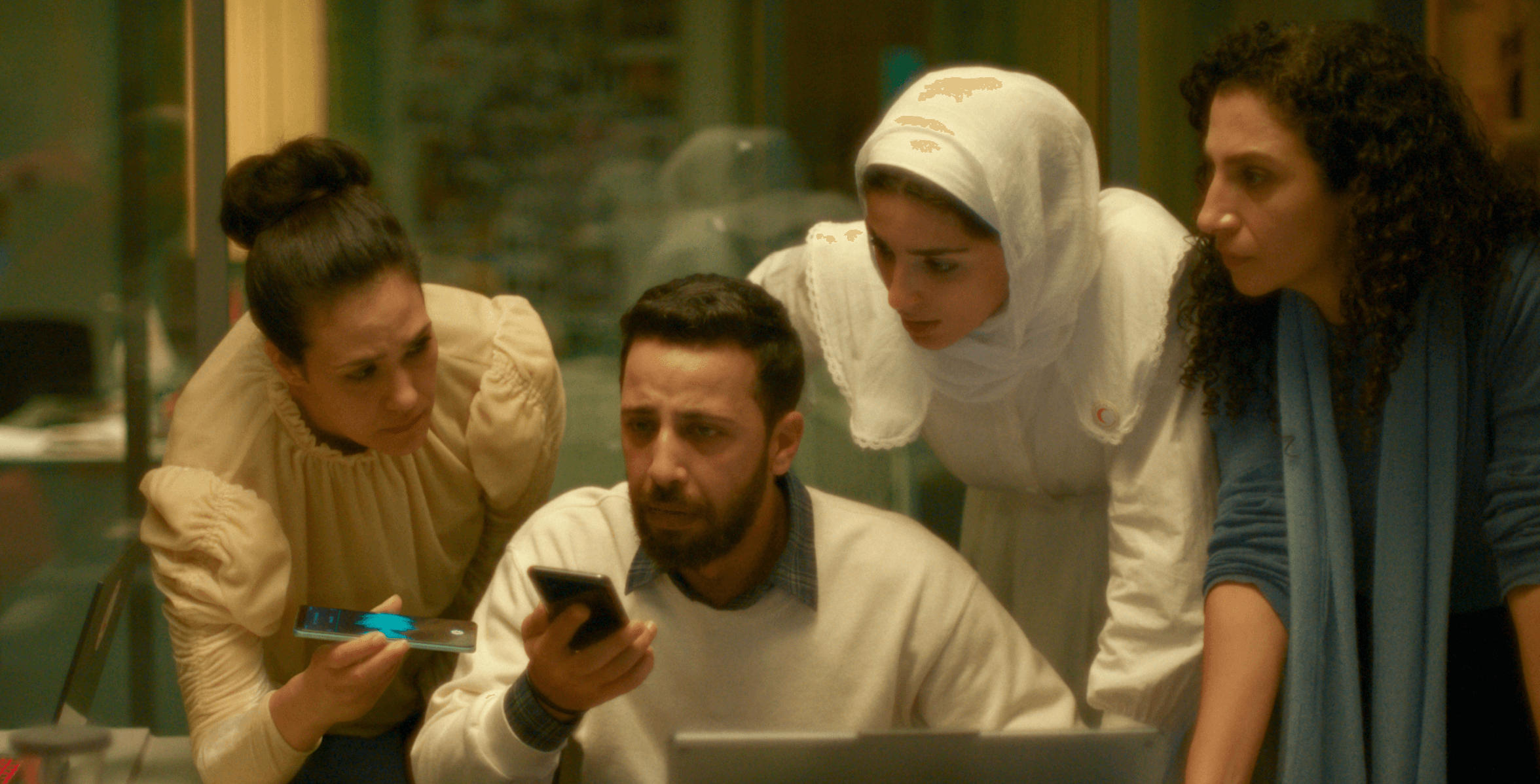
The Voice of Hind Rajab, directed by Kaouther Ben Hania, is a devastating and deeply human film based on real-life events that retraces the final hours of six-year-old Hind Rajab, killed in Northern Gaza by the Israeli Offensive Forces (IOF).
The film opens in the frantic call centre of the Palestine Red Crescent Society (PRCS). Staff are exhausted, traumatised, and overwhelmed by the constant stream of Palestinians from Gaza pleading for help, many of whom they cannot identify, locate, or save. The film quietly exposes the scale of loss in Gaza, the thousands of unnamed victims, each one someone’s child, parent or loved one.
Into this chaos comes the real emergency call from Hind. The film uses her actual audio from January 2024. Hind’s family had tried to evacuate Tel al-Hawa, an area Israel had ordered civilians to flee, but they became trapped in their car as IOF tanks opened fire. What follows is the agonising attempt by PRCS dispatchers to keep her alive on the phone while coördinating a rescue team that was only physically eight minutes away.
The complexity of the rescue becomes painfully clear. The area is designated a military zone by Israel, meaning ambulances have no protection and must wait for the “green light” to enter. At several points, Israeli forces jam the phone lines so communication is cut off, making any rescue attempt even more difficult. The PRCS even speaks with the Coördination of Government Activities in the Territories (COGAT), a unit of the Israeli Ministry of Defence, to help coördinate. It’s a cruel irony, as the rescue team must appeal to the very institution responsible for the violence and suffering, but this is the reality of Palestinians whose every movement and aspect of life and death is controlled by Israel.
Every minute becomes a debate of risk versus duty, causing moral conflict within the team. While speaking to Hind, the team realises she is the only one in the car who survived the attack and is surrounded by the corpses of her family. She is shot, bleeding, terrified, repeatedly begging for someone to come as night is falling. Still, the rescuers cannot move without Israeli permission.
The staff are torn apart by helplessness, yet they stay strong for Hind, telling her she has “the spirit of a warrior.” Hind’s mother also calls in, desperate for news on her child.
Hours later, the green light finally arrives. The ambulance moves in. For a moment, there is a premature sense of relief; they are on the right street, so close to Hind.
Then we hear gunshots, and the line drops, and this time they cannot be reconnected.
The ambulance crew, Yusuf al-Zeino and Ahmed al-Madhoun, were killed. Until this moment, our focus is entirely on Hind, but suddenly the scale widens, and the already depleted medical services have lost even more of their lifeline. And beyond the system, two human beings are gone. Their courage, sacrifice and the depth of their loss hit just as hard.
It would take Hind’s mother 15 days to learn her daughter’s fate, only after Israel lifted restrictions on the zone. When the PRCS team returns, they find the charred remains of the ambulance and the bodies of everyone inside the car. Hind never made it out.
The final scene returns to Hind’s mother, who recalls Hind saying she wanted the genocide to end so she could play by the sea. As her voice fades, the film ends with the sound of waves a gut-wrenching reminder of all the childhoods stolen in Gaza.
The film leaves you with a sick, hollow ache. The rescuers did everything they possibly could, including risking their own lives, yet the outcome was more death, more grief, more stolen futures. This is the reality of the genocide in Gaza.
Notably, the film contains no graphic violence. It doesn’t need to. The audio alone is enough to shatter any emotional distance. Hind is never framed through the lens of identity politics she is just a child, a fellow human being. In the Q&A, the actors emphasised that they are not trying to “humanise Palestinians.” Palestinians have always been human. The issue is the world’s failure to acknowledge it.
Some might question the use of Hind’s real call in a film in a Hollywood-type production, but the director handles it with respect and necessity. This isn’t exploitation, it’s documentation. It is a story the world must hear, especially as Palestinian narratives continue to be erased or dismissed.
The cast — all Palestinian, spoke with raw honesty. They are living this genocide in real time, making a film about atrocities still unfolding. They talked about feeling conflicted standing on a stage discussing “their art” when the film is about genocide, yet simultaneously they felt it was a call of duty for them to tell their stories as Palestinians. There is no separation between the art and the lives they lead. They wished Hind’s story had never needed to be told, but it does, and The Voice of Hind Rajab is just one story out of thousands of Palestinians being killed even to this day. This film is not only a witness but a reminder that we cannot remain passive. It calls on all of us to speak, to amplify

Faizah Cyanide
Latest posts by Faizah Cyanide (see all)
- ON SCREEN | THE VOICE OF HIND RAJAB AT THE LONDON PALESTINE FILM FESTIVAL — November 28, 2025
- REVIEW | ‘FROM GROUND ZERO’ CLOSING NIGHT AT THE LONDON PALESTINE FILM FESTIVAL — December 5, 2024
- LONDON PALESTINE FILM FESTIVAL — THE IZKOR: SLAVES OF MEMORY — November 27, 2024
