Photo credit: Belinda Lawley
As Breakin’ Convention returns with its 2026 programme and UK tour, few crews embody its global, boundary-pushing spirit quite like ILL-Abilities. Known for redefining what breaking can look like on stage, the internationally renowned collective brings their latest work Broken Source to London before taking it across the country.
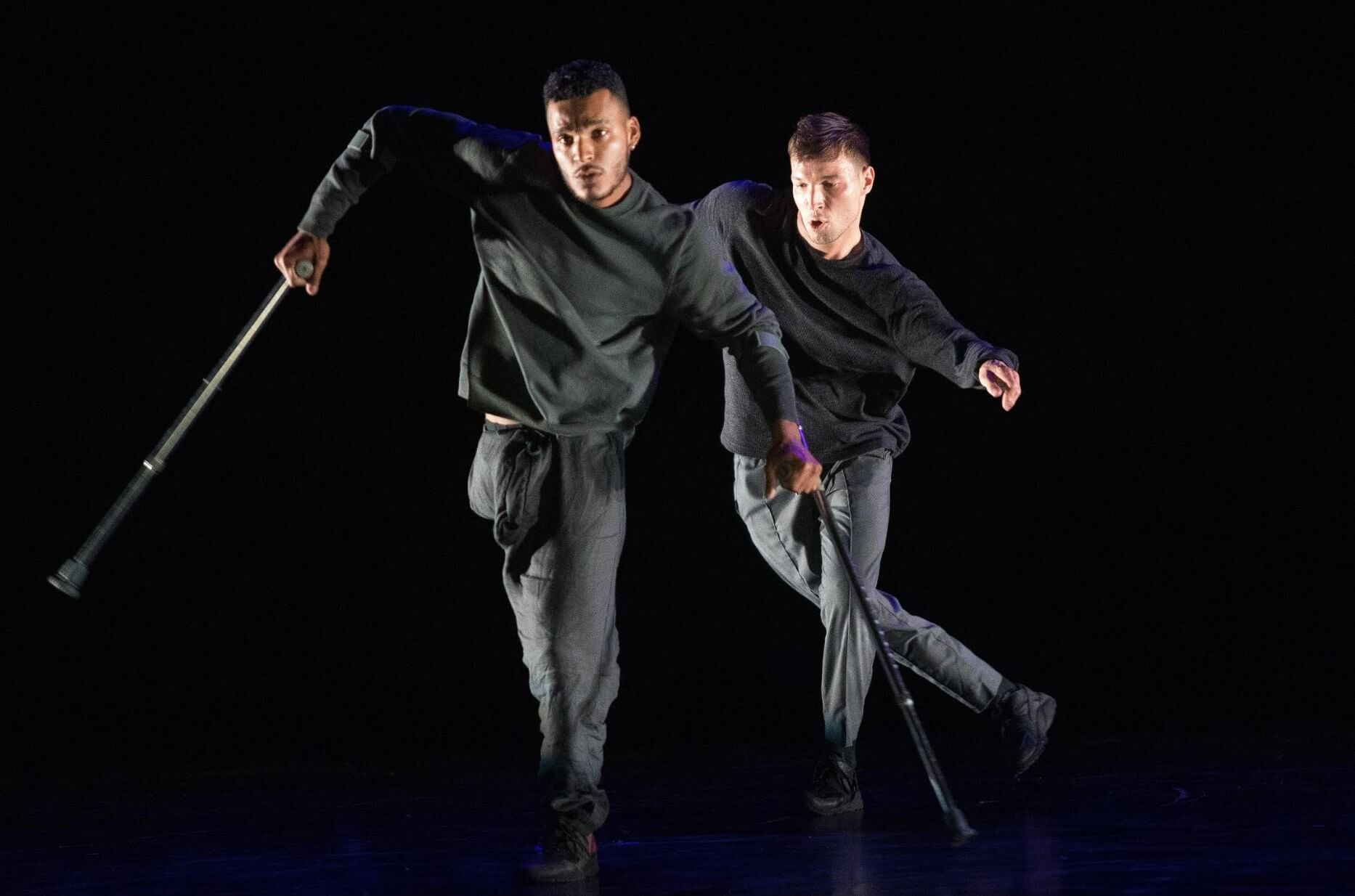
Created as a duet between Redouan ‘Redo’ Ait Chitt and Brazilian B‑boy Samuka, Broken Source explores identity, resilience and the idea that what is often seen as “broken” can in fact be a source of strength. While Samuka, who lost his leg at 14, does not speak English fluently, the two artists developed the work and its ideas closely together, with Redo speaking on behalf of the collaboration.
In this conversation, Redo reflects on the crew’s long-standing relationship with Breakin’ Convention, the evolution of hip hop theatre, and how ILL-Abilities continue to challenge perception through movement, storytelling and unapologetic authenticity.
You are returning to Breakin’ Convention with a new work. What does this platform mean to ILL-Abilities at this stage in your journey?
Breakin’ Convention has been part of our story for many years. It’s one of the first platforms that really embraced what we were doing in a theatrical way. We performed in 2012, 2013, 2014 + the UK tour and in 2023. In 2013 we we’re even nominated for an Olivier Award in the category ‘Outstanding Achievement in Dance’.
Coming back to the festival almost feels like coming home. It’s such a lovely team to work with and this year also doing the UK tour we are super excited to meet people and other talent throughout the country!
Breakin’ Convention has played a major role in shaping hip hop theatre globally. Why do you think spaces like this still matter today?
Platforms like Breakin’ Convention give those stories a stage without diluting them. It’s always a great mix between established artists and new and upcoming talent. The core is still hip hop but it’s great to see it’s evolvement within the culture and still keeping it grounded and authentic.
You are coming back by popular demand. What do you think audiences connect with most when they see ILL-Abilities live?
I think people connect with the honesty and the heart we pore into this dance. Of course there’s the skill, technique, and the physical aspect, but what really stays with people is the human side. Vulnerability, resilience and changing perception. And overall we just want to show incredible dancing.
Has your mission or message changed since the early days of the crew?
The core hasn’t changed, but the way we express it has definitely evolved. Over the years, our work has expanded far beyond just performing. We’re active in theatre, competitions, judging, teaching, motivational speaking, commercial, organizing events, and even politics.
The crew has also grown. Today we are eight dancers representing six different countries, and each member is not only part of the collective but also building their own career in their home country. Everyone brings a high level of performance and a unique perspective.
So while the mission remains the same, the way we live it and share it with the world has become much broader and more layered.
Broken Source premieres at the festival before heading out across the UK. What is the core idea behind the piece?
At its core, Broken Source explores where our strength really comes from. We often see brokenness as something negative, but for us, it’s also the starting point, the source of creativity, identity, and movement. It’s about embracing the parts of ourselves and with this piece we encourage people to do the same.
The title suggests something fractured but also foundational. What does Broken Source mean to you?
To me, it reflects the idea that what we consider “broken” is actually part of our foundation. Our experiences, our challenges, our differences, they shape how we move, how we think, how we create. It’s not about fixing something, but about recognizing its value.
This is a duet rather than a full crew piece. What drew you to a more stripped back format?
ILL-Abilities is an international crew, with each dancer based in their own country spread across six different parts of the world. Everyone has their own schedule and commitments, so coming together as a full group isn’t always easy.
Because of that, we often work in smaller formations. It allows us to be more flexible, to reach more places, and to keep creating consistently. But beyond the practical side, there’s also something exciting about it artistically. A duet gives us the chance to create something more intimate and focused, and to offer work that feels unique and tailored to each context we step into.
How did the collaboration come together creatively, especially working across different countries and experiences?
It was definitely a challenge. Samuka has been on a world tour, performing with Hervé Koubi’s company in Sol Invictus, and at the same time I was busy in the Netherlands filming and presenting a dance TV show. So finding time to create together wasn’t easy.
On top of that, we didn’t have dedicated funding for the creation, so we really had to invest in it ourselves. We used performances along the way to help finance the process, and made the most of every moment we could spend together.
In between travels and tours, Samuka came to the Netherlands and we focused on rehearsing as much as possible. We even managed to organize a try-out, which was important for us to test the piece in front of a live audience and feel how it connects. It was a process built on commitment, flexibility, and really making it work despite the circumstances.
ILL-Abilities has always challenged perceptions around ability and movement. How does Broken Source push that conversation forward?
This piece moves beyond just what you see physically. It’s not only about ability or disability, but it’s about identity, origin, and perception. We invite the audience to look deeper, to question their assumptions, not just about us, but also about themselves.
How important is it for you to represent real lived experiences on stage without being defined by them?
It’s very important. Our experiences shape us, but they don’t limit us. On stage, we want to be fully human and not reduced to a label or a story. It’s about balance: being honest about where we come from, while also showing that we are more than that.
Breaking comes from battles and cyphers. What excites you about translating that into a theatre setting?
What we love about theatre is the space it gives you to really take your time and tell a story. Movement translates very differently on a stage through lighting, atmosphere, and structure. You can build something more layered and intentional.
For us, it’s actually refreshing to step away from the battle or cypher when we’re in a theatre setting. Those spaces are about energy, exchange, and quick go downs, while theatre allows for reflection and depth in a different way. It challenges us as dancers to explore new dimensions of our craft.
That contrast is what excites us most, being able to carry the essence of breaking into a completely different environment, and discovering what it can become there.
How do you stay true to hip hop foundations while building narrative-driven work?
The narrative is just another layer. If the foundation is real, the story will feel real too.
This tour reaches cities across the UK, from major hubs to smaller scenes. Why is it important for work like this to travel so widely?
Because hip hop is universal and can fit in everywhere. It’s not just the big cities or established scenes. Bringing the work to different places creates new connections, new conversations.
The beauty about the festival is that you don’t have to be a hiphop head to enjoy the performances. Anyone can relate and be surprised!
Do different audiences respond differently to your work, or is the reaction universal?
Both. The way people express it might differ, but the feeling is often the same. The themes we touch on are universal and human.
This year’s lineup includes works like TRAPLORD by Ivan Blackstock, which explores masculinity and mental health. Do you feel hip hop theatre is becoming more reflective and socially engaged?
I feel hip hop has always been reflective and socially engaged that’s how it started in the first place. It’s a way of expressing through movement, words, music, visuals and it’s great to see many artists addressing everyday themes throughout their work.
Where do you see the future of hip hop theatre heading?
I see it moving into more structured and established spaces, with growing interest from the classical and institutional world. There are more crossovers happening between hip hop theatre, dance, even other art forms and that’s opening new doors.
At the same time, I don’t think hip hop theatre is fully normalised yet in many places. It’s still growing into those spaces. But you can clearly see the shift… more platforms, more recognition, and more diverse audiences engaging with the work.
What do you want audiences to take away from Broken Source?
I want people to leave with a different perspective on themselves, on others. To see strength in places they once saw weakness. To feel something real, to see the beauty of movement and to feel touched and inspired.
When the tour finishes in June, what would success look like for you as a crew?
Success would be connection. If we’ve moved people, started conversations, left a mark every place we went. And if we inspired even one person to look at themselves differently. And for us as a crew, continuing to grow together and keep the movement going!
Tour dates for Breakin’ Convention
Line up varies, check venue website for details
1–3 May Breakin’ Convention Festival at Sadler’s Wells, London https://www.sadlerswells.com/whats-on/breakin-convention-festival-2026/
9 May The Marlowe, Canterbury https://marlowetheatre.com/shows/breakin-convention‑3/
12 May Tyne Theatre & Opera House, Newcastle https://www.tynetheatreandoperahouse.uk/whatson/breakin-convention-tour-2026/
15 & 16 May Royal Concert Hall, Nottingham https://trch.co.uk/whats-on/breakin-convention/
20 May Belgrade Theatre, Coventry https://www.belgrade.co.uk/events/breakin-convention/
23 May Tramway, Glasgow https://www.tramway.org/event/f1eb772a-ea09-4b69-ac7e-b39b009ba20e/
27 May Brighton Dome, Brighton + family matinée https://brightondome.org/whats-on/Lll-breakin-convention/
30 May Lighthouse, Poole + family matinée https://www.lighthousepoole.co.uk/event/breakin-convention-2026/
3 June CAST, Doncaster https://www.castindoncaster.com/events/breakin-convention-international-festival-of-hip-hop-dance-theatre/
6 June The Grand, Blackpool https://www.blackpoolgrand.co.uk/event/breakin-convention


Rishma
Latest posts by Rishma (see all)
- ON STAGE | JULIUS CAESAR REMIXED AT OMNIBUS THEATRE — September 23, 2026
- EVENT | PASS THE TORCH FOR TY RETURNS TO BRIXTON FOR ITS SIXTH ANNUAL CELEBRATION — August 13, 2026
- DIASPORA CALLING! REVIEW: LAURYN HILL, ERYKAH BADU AND 35,000 PEOPLE CELEBRATE THE POWER OF BLACK CULTURE — August 13, 2026
