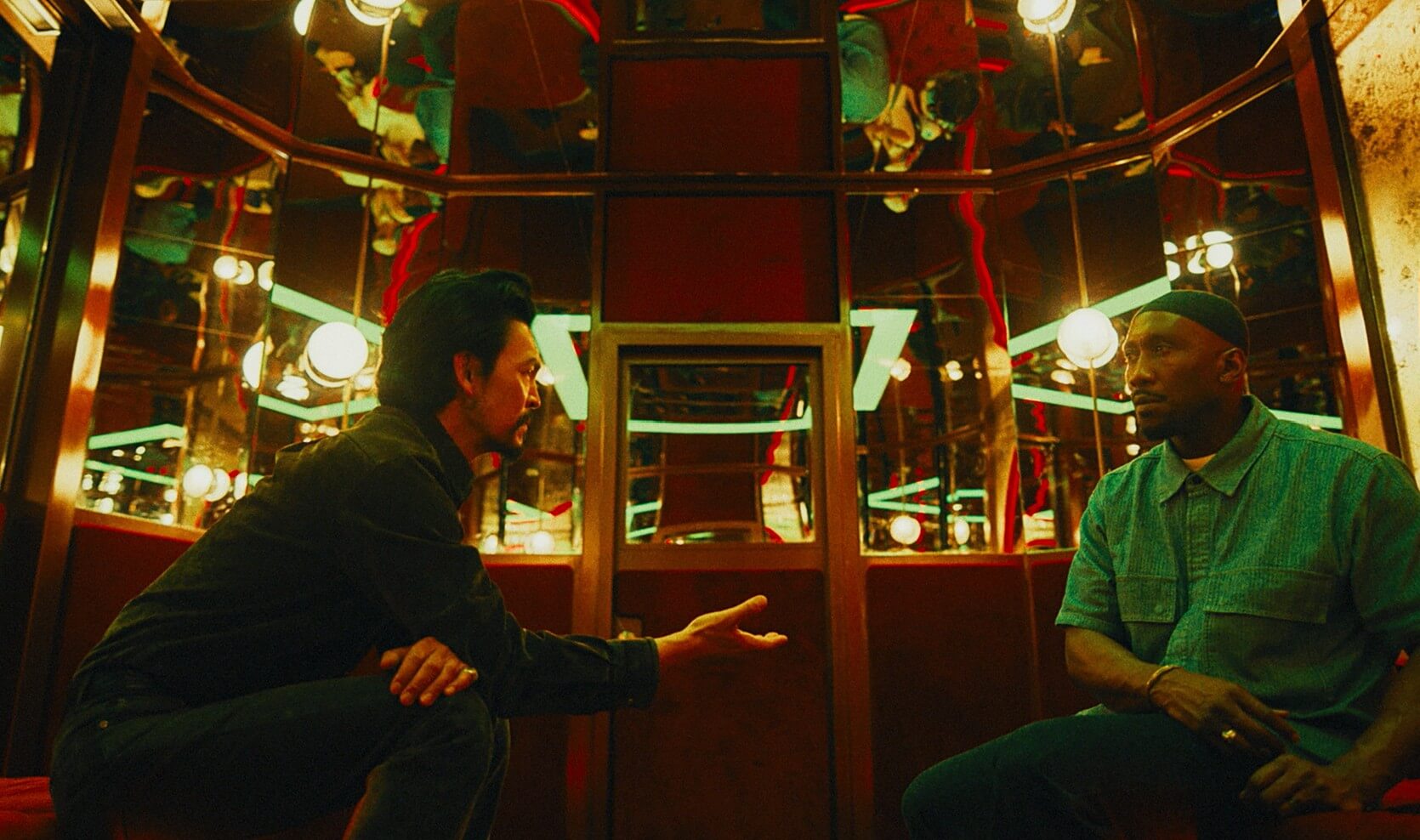
At the BFI London Film Festival, we joined two time Academy Award winner Mahershala Ali for a conversation about his latest film, the complexities of Black fatherhood and why he feels he is only just getting started.
By Salina Zaher (SalinaTranslates)
A contract killer searching for breast milk for his newborn daughter is not a storyline I would typically associate with an action thriller. Yet in Bassam Tariq’s Your Mother Your Mother Your Mother, this unusual premise opens up a wider exploration of faith, grief, fatherhood and the contradictions that make us human. You have to watch this movie!
Mahershala Ali plays Latif, a devout Muslim and professional hitman whose life changes following his wife’s death. Left caring for their three children, he must navigate the challenges of parenthood while remaining entangled in a dangerous criminal world. His attempts to protect his family bring him face to face with the consequences of the life he leads.
During the Screen Talk, hosted by the wonderful film critic and broadcaster Amon Warmann, Ali spoke about the film, his career and the stories he wants to tell. As a journalist of Palestinian and Lebanese heritage, I found myself listening particularly closely when the conversation turned to what fulfilment means for him as a Black, Muslim actor in the world of Hollywood.
Mahershala Ali on the complexity of Black fatherhood
Ali spoke about the lack of complexity often afforded to Black fathers on screen, particularly when their stories involve Muslim identity.
“I don’t feel like Black fathers have the dimensionality that I would love for them to have,” he said.
For Ali, the opportunity in Moonlight or in this film was about humanising a character whose identity and actions might otherwise make him easy to dismiss. Latif believes he is pursuing justice, but his understanding of it is shaped by his perception of racial inequality and failures of accountability within American society.
His wider reflection on storytelling stayed with me:
“If you’re not at the centre of that story, that means you’re on the periphery and the edges of that story,” he explained.
I connected with this idea because I know how much the stories told about a community can shape how it is understood beyond its own boundaries. Our histories, identities and experiences are rarely simple, yet they can be reduced to a handful of familiar narratives when other people are doing the telling.
The Palestinian and Lebanese experiences are distinct from the experiences Ali was discussing, and I would never suggest otherwise. But his question about who gets to occupy the centre of a story resonated with me. Who gets to be complicated? Who gets the space to explain themselves? And who is too often spoken about without being fully understood?
For me, these questions make representation about more than visibility. They are about allowing communities to exist in their full complexity, with all the contradictions, histories and humanity that entails. Through Latif, Your Mother Your Mother Your Mother explores what happens when faith, fatherhood and violence collide, resisting the temptation to reduce a person to a single aspect of who they are.
Mahershala Ali on finding his creative voice
Beyond the film, I was drawn to Ali’s reflections on identity and creative fulfilment.
“I just found myself really looking to find, like, what is my thing? Or what are my things? Who am I?”
He recalled his father winning a major dance competition when he was young, giving him an early example of what it meant to pursue something unconventional. That experience helped him recognise the value of listening to an inner voice, even when the path ahead might seem impractical to others.
Although Ali had found success in other areas, acting offered him a particular sense of fulfilment. Exploring characters and questioning why certain performances resonated helped him understand himself more deeply.
What I appreciated most was his acknowledgement that acting does not fulfil every creative need. He spoke about making beats on his MPC and writing poetry, explaining how different artistic outlets come together to help him feel more fully himself.
For creatives working across music, film, writing and the wider arts, I think there is something important here. Our creative identities are often shaped by more than individual ambition. They can also be rooted in where we come from, the communities that raised us, the histories we carry and the experiences we feel compelled to articulate.
That does not mean every artist has to tell their community’s story. But it does raise an interesting question about what drives us to create in the first place, and whether we are making space for the things that genuinely matter to us.
Why Mahershala Ali feels he is only just getting started
Towards the end of the conversation, Warmann asked Ali about his previous statement that, despite working as an actor since 1993, he felt as though he had only just started.
Ali spoke about feeling increasingly connected to the stories he wants to tell and using more of his creative capacity. He also reflected on balancing his ambitions with family life, including making time for his daughter.
One line particularly stayed with me:
“I finally feel tired in the right way.”
I found this a refreshing way to describe the relationship between work and fulfilment. There is a difference between being exhausted from constantly chasing something and feeling tired because you have given yourself fully to work that matters to you.
Amon Warmann also did a great job of drawing connections between Ali’s different roles while highlighting their differences. From Moonlight and Green Book to Spider-Man: Into the Spider-Verse and Your Mother Your Mother Your Mother, Ali has explored very different characters, often bringing out the contradictions or dualities within human nature. And no… there were no Spiderman spoilers unfortunately.
Leaving the Screen Talk, I found myself thinking about how easily we can lose sight of ourselves while building careers that look successful from the outside. We chase opportunities, navigate expectations and sometimes become so focused on getting somewhere that we forget to ask whether the path we are following fulfils us.
For me, Ali’s reflections connected ambition with something deeper: the need to feel that our work is meaningful, that our creative voices have somewhere to go and that we are not abandoning important parts of ourselves in pursuit of success.
As a Palestinian and Lebanese journalist, I am particularly interested in how identity, community and representation shape the stories we tell. But I also see this as a question that reaches across creative industries and backgrounds. Whether we make music, write, direct or perform, our work is influenced by the worlds we inhabit and the things we want others to understand.
Ali may feel he is only just getting started, but I left with a renewed appreciation for the fact that creative fulfilment is not simply about reaching a particular level of success. It is also about understanding what you want to say, whose stories matter to you and how much of yourself you are willing to bring to the work.
Your Mother Your Mother Your Mother is scheduled for UK cinema release on Friday, 20 November 2026.

Salina Zaher
Latest posts by Salina Zaher (see all)
- SCREENTALK | A FATHER, A BELIEVER, A HITMAN: INSIDE MAHERSHALA ALI’S WORLD — October 23, 2026
- ON STAGE | RETURN OF THE GODZ REVIEW: A WILD BLEND OF MYTHOLOGY, CIRCUS AND COMEDY — June 16, 2026
- BOOK CORNER | FINDING COLOUR AGAIN IN A GREY WORLD: A CONVERSATION WITH ZOULFA KATOUH — June 11, 2026
