
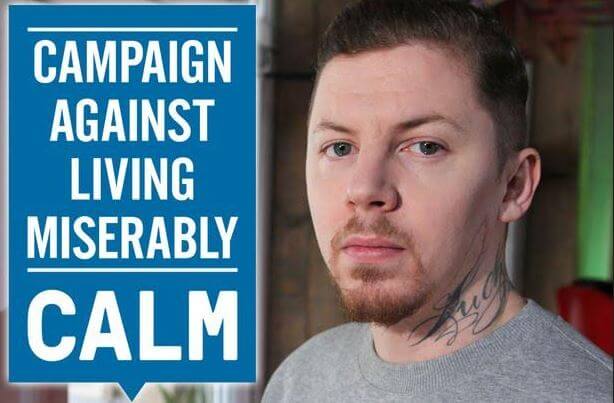
 Attending a corporate company talk on wellbeing and mental health, the last person I would expect to see as a headline speaker would be Grime artist Professor Green, real name Stephen Manderson. Intrigued at what he had to share but also how this corporate (and much older) crowd would receive him I took my seat in a full room. As I waited for the talk to begin, I felt a small sense of pride to see an artist such as Green make it this far, jumping social barriers. I also wondered if the crowd consisting of many scientists knew that he was not in fact an actual professor. This was briefly addressed later on where he joked his chair was in ‘Horticulture’ which I’m sure went above some heads.
Professor Green has come a long way as an artist but also as a spokesperson for mental health and patron of the anti-suicide charity CALM. As a child, Green had to deal with the tragedy of his father taking his own life. Thus began his struggle with mental health, often a taboo subject especial for young men. Now openly able to discuss his mental health issues and struggled with anxiety, Green took the step to be vocal about his experiences in the documentary outlining his journey, ‘Suicide and Men’. Hoping to open up the doors of discussion and transparency for others.
Green’s rise to fame saw him rocket into the limelight leading to a chaotic lifestyle. The stress and pressure lead him to have a seizure despite not being epileptic, this caused him to take a look at how he was living and how he could improve his lifestyle to maintain his health and in turn his focus. He admitted it was not as simple as that, “Every lesson I’ve learned by getting something wrong or right is beneficial — that’s life, we’re all works in progress.
One of this main tips to controlling his own mental health is to take care of his body, which then affects his mental capacity to function, “It comes down to making better decisions,” he said. “I know what makes me happy and what doesn’t. If I exercise I make better decisions. If I sleep well I make better decisions. The more better decisions, the better life gets.” You can tell why he now gives talks to those seeking advice on a better work-life balance. Emphasizing the importance of not holding onto negative thoughts and learning to let them go the crowd had his full attention. To let go of things out of our control, no to worry about them as that negatively impacts decisions we actually do have the power to make.
Commenting on how self-destructive he world is today, Green commented on what he would like to see for the future. “I would just like to have even stronger bonds with people that I count and consider as my friends and family. I would like to see them well and be well. I would like to have my own children and still be learning — that’s when I’m happiest.”
Shocking some audience members at points with his colorful language, I respected that he did not change himself to give this talk, that he remained authentic to himself. His ability to touch this audience that he normally wouldn’t have interacted with shows we can all learn from one another no matter who we are. That social influencers such as himself have the power to change perceptions.

Latest posts by (see all)
- NAS: LDN SEASON, WHEN TWO ARTISTS COLLABORATE BY SAL FRECKLES — September 16, 2026
- FILMS TO HAVE ON YOUR RADAR AT THE 70TH BFI LONDON FILM FESTIVAL — September 4, 2026
- REVIEW | DJ JAZZY JEFF AT KOKO LONDON: A MASTERCLASS IN MUSICALITY — August 25, 2026
