

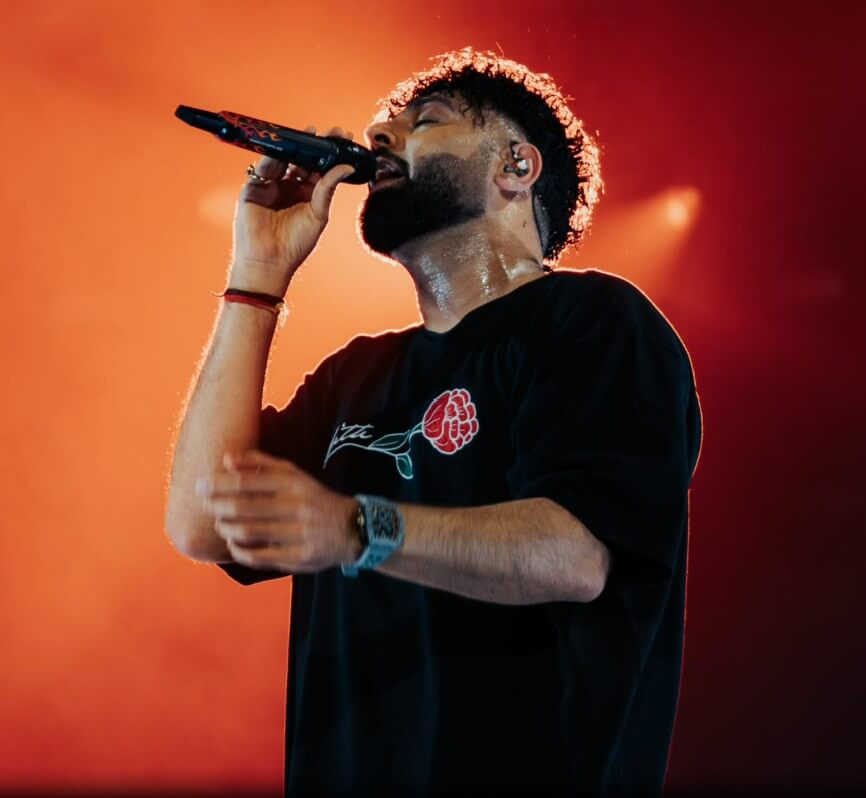
Even when the noise offstage gets louder, Badshah is proving that his real arena is still the stage, and few in desi hip-hop are operating at this level right now.
At The O2 Arena, the scale alone told the story. This was not just another tour date. It marked a milestone moment, with Badshah stepping in as the first Indian rapper to headline the venue, placing desi hip-hop firmly in one of the world’s most recognisable live music spaces.
Shoutout to UK events promoters and curators Desi Beatz, who kept the crowed warmed up nicely with their opening act of DJs, and Broadcaster Harpz Kaur on hosting duties set the tone nicely for what was one of the most anticipated events of the year so far.
From early in the night, the intent was clear. A full-length set stretching across hours pulled from a catalogue built for mass appeal, running through chart hits and crowd favourites that have defined his run over the past decade. With thousands in attendance and a production built for arena scale, the show leaned fully into spectacle.
The stage setup and lighting played a major role in that. Clean visuals, sharp transitions, and a lighting rig that moved with the tempo of each track elevated the entire performance, giving the show a polished, global feel rather than something scaled down for tour convenience. Badshah met that level with strong stage presence and constant energy, moving with confidence and keeping control of the room throughout.
Midway through, the energy lifted again when Nora Fatehi stepped out for “Garmi.” It landed exactly how it was supposed to. Big, immediate, and designed for a viral moment.
Some of the strongest reactions came from the crowd during tracks like “Kala Chashma” and “Tareefan.” These were the moments where the performance shifted from artist-led to crowd-driven.
At points, all you could hear was the audience singing back every word, turning the arena into something closer to a shared experience than a one-sided show. In those moments, it was easy to forget just how much impact Badshah has had on music culture over the past few years alone.
What makes this show worth looking at closely, though, is the timing.
Coming off backlash tied to “Tateeree,” this was a performance carrying extra weight. The show felt locked in. Hooks landing, crowd fully engaged, an artist in control of a massive room. A decade ago, this kind of night for Indian hip-hop in London would have felt unlikely. Now it is happening at arena level, with thousands turning up and staying locked in from start to finish. That shift matters.
Whether you view Badshah as a commercial force or a contested figure in the culture, this performance confirms his position in the conversation. Not just as a hitmaker, but as someone helping define how far desi hip-hop can travel.
Right now, that trajectory is only moving in one direction. Badshah did not disapoint.

Nadiya Shay
Latest posts by Nadiya Shay (see all)
- REVIEW | BADSHAH MAKES HISTORY AT THE LONDON O2 — March 26, 2026
- INTERVIEW | KINGJU1C3 ON HIS CAREER IN MUSIC AND HIS NEW ALBUM — June 23, 2025
- NEW MUSIC | INFINITE COLES DROPS NEW TRACK FT. MALEIGH ZAN & JULZ — June 19, 2025
