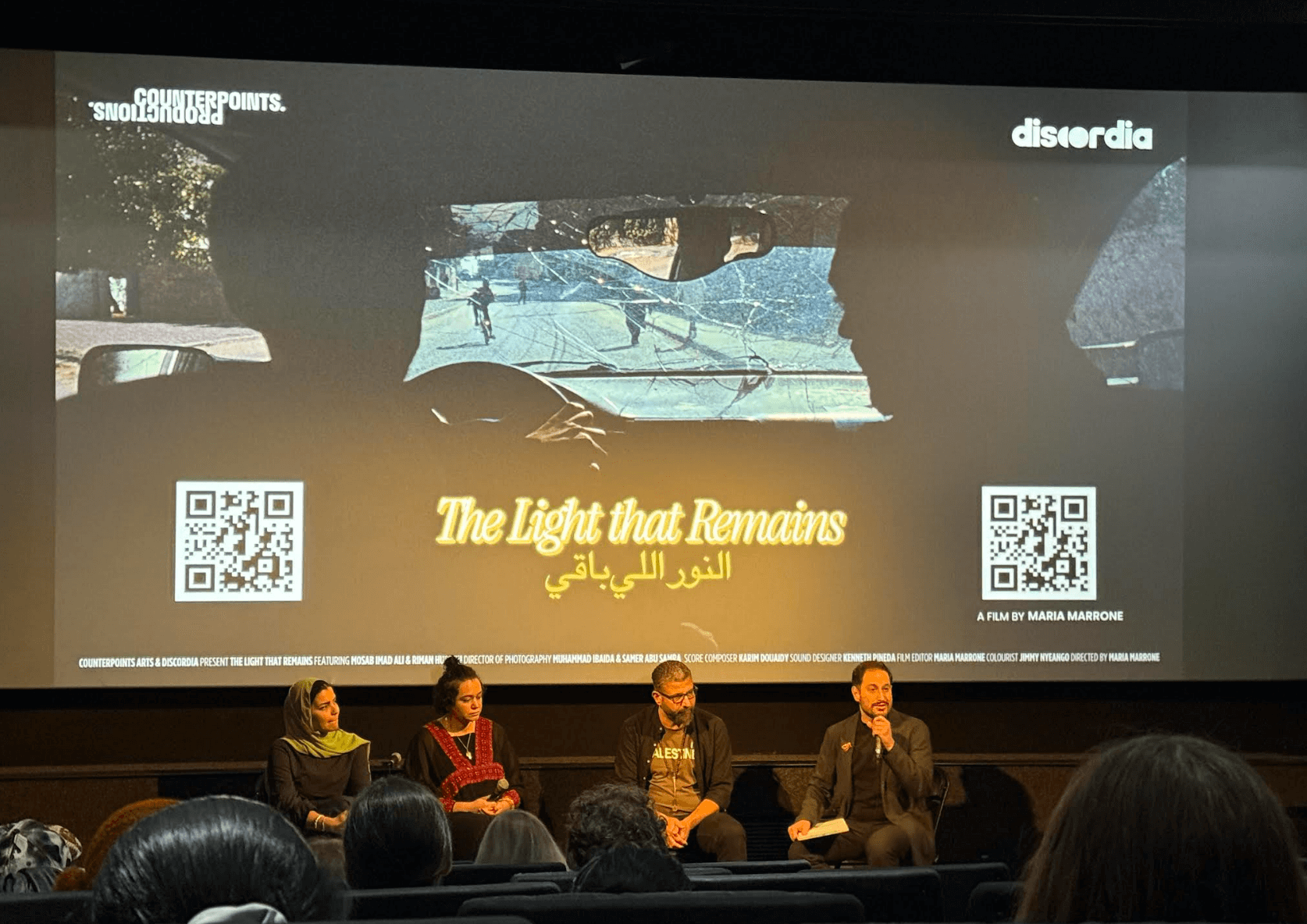
The Light That Remains explores the vast, unmet need for trauma support among Palestinians, especially young children who are enduring a genocide in real time. For the first time in history, the world is witnessing this live on their phones through social media. Many Palestinian children are now showing signs of severe trauma: phobias, insomnia, and in some cases, complete loss of speech. Their parents who are unable to protect them, carry a profound sense of helplessness and guilt. Yet there is a recognition that existing is resisting.
The film centres on Mosab Ali, a Palestinian whose family is evacuated from Gaza for medical treatment but he himself is unable to leave. Drawing on his background as a software engineer, Mosab creates an innovative virtual-reality programme designed to help survivors, especially children, cope with the psychological impact of genocide.
As the genocide continues in real time, the film follows Mosab as he builds TechMed Gaza under siege, while also helping everyone around him with their tents, and finding food and water. It’s through service to others that he finds purpose, and a way to safeguard his own mental wellbeing.
Halfway through the film, we learn that Mosab was killed in an Israeli strike. His team continues TechMed Gaza in his honour, carrying forward his vision. It’s a cold shock to the system to hear another story of a Palestinian who helped his community in multiple ways only for him to be killed. You sense his loss is wider then to only his own family, it is a loss to humanity.
The screening was followed by a Q&A with director Maria Marrone and panellists Hala Sabbah (The Sameer Project) and Mustafa Jayyousi (TechMed Gaza).
One of the points raised which stood out to me was that many NGOs do not prioritise Palestinian wellbeing, they do not really care as Palestinians merely become numbers, quotas, deliverables. But companies like TechMed, created by Palestinians, exist because they genuinely care for their communities that they are a part of, they understand the trauma because they live it too. For example some children who have received therapy have been too weak to speak as they faced the famine, others have been wounded losing limbs and unable to access prosthetics.
Those Palestinians working in supporting others and in small numbers as they are targeted and depleting. Even therapists are carrying fresh trauma while trying to support others. One therapist gave 185 sessions in a single month.
In Gaza, where the genocide is ongoing, no one is “healed”; people are being collectively retraumatised repeatedly. And unlike Western therapy models centred on talk-based intervention, therapy in Gaza integrates spirituality and Islam as core pillars of healing.
Palestinians hold on to moments of joy, like watching a sunset, to continue living. This comes from the quote, “ith hardship comes ease” Qur’an 94:5–6, often explained to mean that the ease exists within the hardship itself, not after it. To live as a Palestinian is an act of resistance. Service to others becomes a form of healing in itself.
At the end of the talk when asked for a call to action, the panel was clear: this is not a humanitarian crisis. It is a man-made genocide perpetrated by colonial powers. Charity alone is not solidarity. True solidarity means supporting the liberation of Palestine and with it, the liberation of Sudan, Congo, and all peoples suffering under the same systems of exploitation and violence.

Latest posts by (see all)
- ON STAGE | JULIUS CAESAR REMIXED AT OMNIBUS THEATRE — September 23, 2026
- NAS: LDN SEASON, WHEN TWO ARTISTS COLLABORATE BY SAL FRECKLES — September 16, 2026
- FILMS TO HAVE ON YOUR RADAR AT THE 70TH BFI LONDON FILM FESTIVAL — September 4, 2026
